
TOOTH BROKEN AT THE ROOT: WHAT TO DO AND HOW WE FIXED IT WITH A SAME-DAY IMPLANT…
A tooth that breaks at the root, without warning, tends to cause a great deal of alarm.
It doesn’t hurt the same way a cavity does, nor does it give warning like an infection: quite simply, from one moment to the next, the crown of the tooth separates and what remains visible is only a part of the tooth, level with the gum. The first question almost any patient asks is always the same: is there a solution to this, or am I going to lose the tooth for good?
The good news is that, in many cases, there is indeed a solution, even when the tooth cannot be preserved. What changes is the approach: rather than trying to save a tooth that is no longer viable, the goal becomes replacing it in the most conservative and predictable way possible, taking care of the bone and the aesthetics from the very first moment.
In this article we share a real case treated at our clinic: an upper premolar with a fractured crown, practically “decapitated” at gum level. We explain, step by step and in plain language, how the extraction and implant placement were approached, and what aspects we took into account so that the result would be stable and functional from day one.
When a tooth can no longer be saved: fracture below the gum line
Not all dental fractures are the same. A superficial crack in the enamel can be resolved with a reconstruction or a crown. But when the fracture affects the part of the tooth that lies below the gum line, the situation changes completely: there is no longer enough healthy structure left on which to support a new crown, however well it is reconstructed.
This happens more often than people think in teeth that have already been treated with root canal therapy (colloquially known as “killing the nerve”). A root-canalled tooth continues to function, but having lost part of its vitality and internal structure, it can become more fragile in the face of knocks, hard bites or the accumulated wear of the years. When the fracture reaches this point, we speak of a “decapitated” tooth: the crown has been lost and only the root remains.
Before deciding how to proceed, it is essential to check the condition of that root. In this case, the tooth had previously undergone root canal treatment, but showed no apical lesion, that is, no signs of infection at the tip of the root. This is a relevant finding, because a root with no active infection allows for more straightforward treatment options than if there were an abscess or significant inflammation in the bone.
The solution: careful extraction and implant placement in the same procedure
Once it was confirmed that the tooth had no viability, the next step was to plan its extraction in the least aggressive way possible for the surrounding bone. This is key: the better the bone is preserved during extraction, the better the conditions afterwards for placing a stable implant.
What is tooth sectioning and why is it used?
To remove the tooth, tooth sectioning was carried out, a technique that involves dividing the root into smaller fragments before extracting it, rather than pulling it out as a single piece. Put simply: it’s like dismantling something in parts that, if removed all at once, could damage the bony “socket” surrounding it. By splitting the root, less force is needed to remove it, and the bone wall is better protected, which is especially useful when an implant is planned immediately afterwards.
The implant: minimal drilling and bicortical anchorage
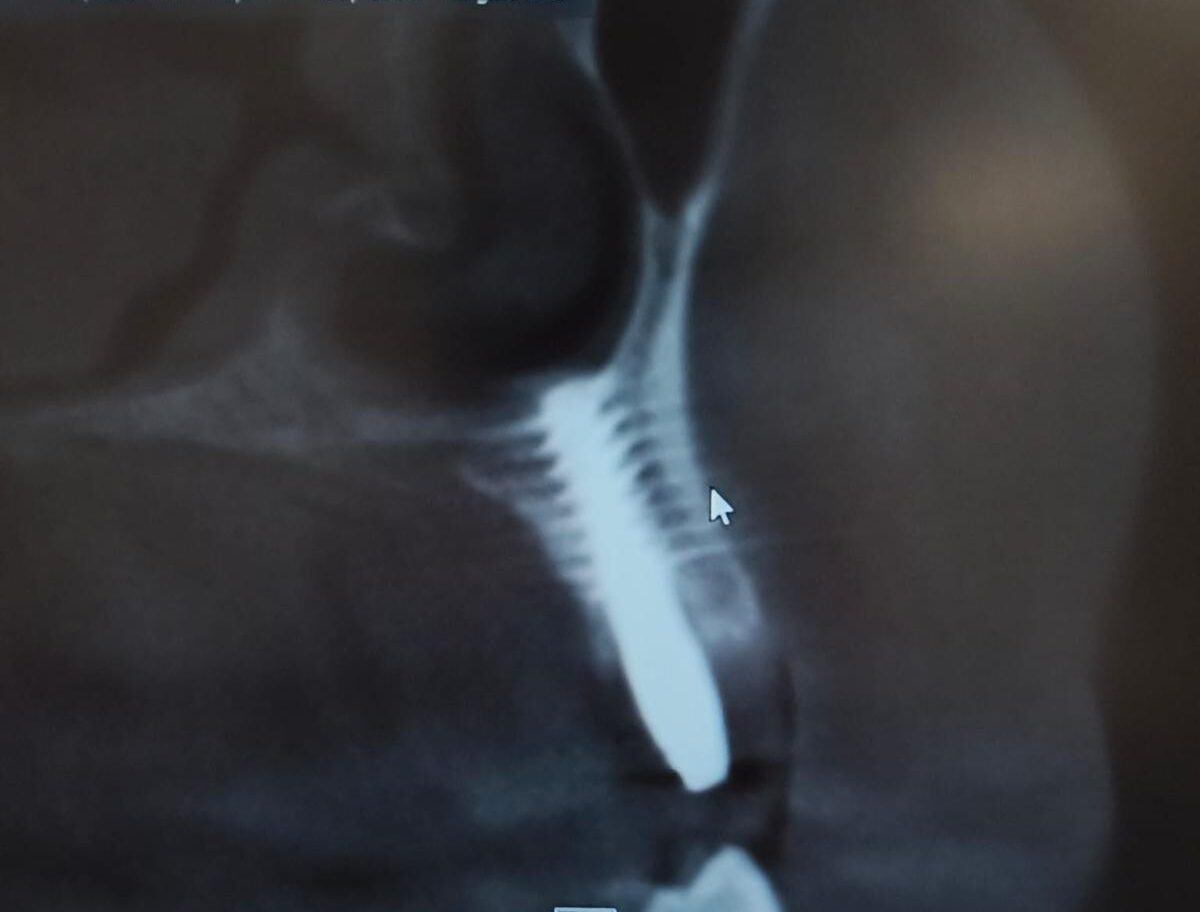
Immediately after the extraction, a 5 × 14 mm AZ Implants implant was placed. Two technical details are especially relevant in this case: * Minimal drilling: the bone bed was prepared with as little bone removal as possible, making the most of the density and structure already present. * Bicortical anchorage: the implant was anchored in two areas of denser bone (known as the cortical plates), which provides greater initial stability than would be achieved by relying solely on the spongier bone at the centre. In practice, this approach has one very specific aim: for the implant to be firm from the very first moment, something especially important when, as in this case, it is placed on the same day as the extraction.
The provisional crown: a natural-looking tooth while the bone heals
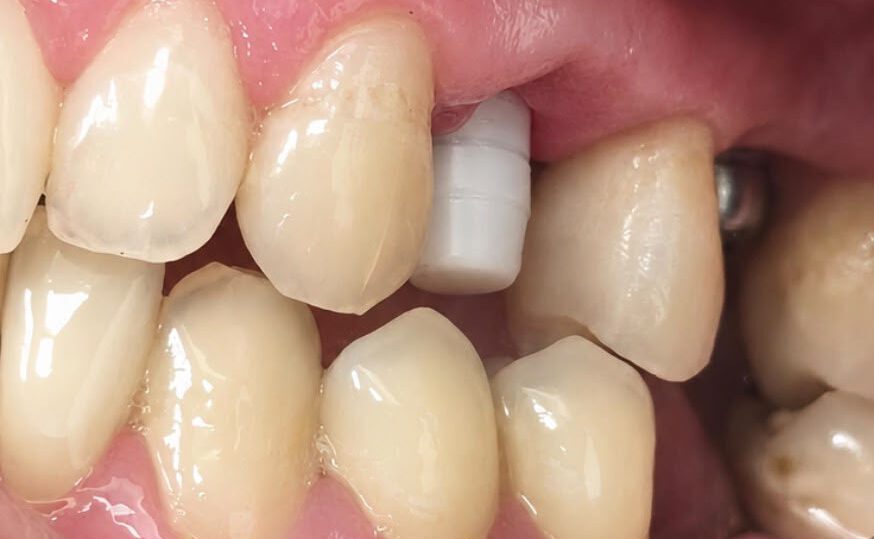
Treatment was completed with a telescopic provisional crown, made of resin and fitted without the need for cement. This has an important practical advantage: while the bone undergoes its healing process around the implant (known as osseointegration), the patient has a natural-looking, functional tooth, and the clinical team can easily remove and check the provisional if necessary, without having to force or lever off any cement.
When treatment involves several teeth: healing in phases
In cases where a patient needs more than one implant, it is common for not all the teeth to be at the same stage at the same time. While one area may already have its provisional crown in the mouth, another may still be in the healing process, awaiting proper integration of the bone and the implant before moving on to the next prosthetic steps.
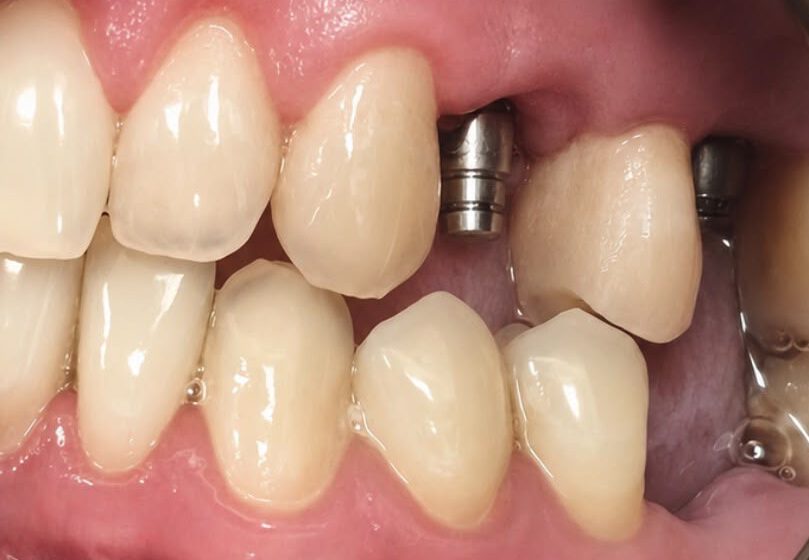
This way of working in phases is not an unforeseen event: it is part of the treatment planning and allows the progress of each implant to be monitored individually, respecting each patient’s biological healing times.
What is the tooth like day to day?
One of the aspects that most concerns patients is whether, after a treatment like this, they will be able to return to their normal routine: eating, speaking, smiling and even travelling. In this particular case, the patient has reported no pain following the procedure and has been able to incorporate the new tooth into daily life with no difficulty.
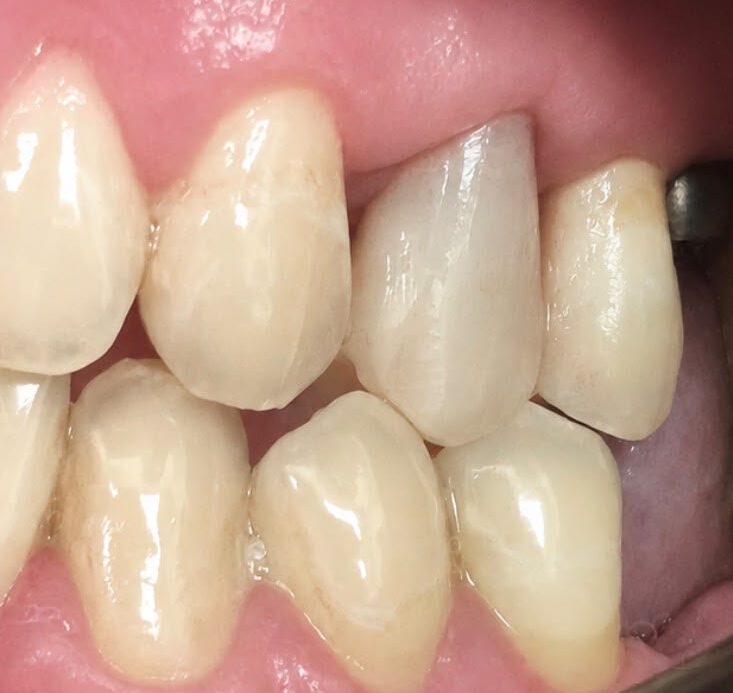
Each patient and each mouth is different, and recovery times can vary depending on individual factors, such as the amount and quality of available bone, the number of teeth treated or the patient’s general state of health. For this reason, any activity — including travel — should always be assessed together with the professional who carried out the treatment, as they are best placed to know how each case is progressing.
Frequently asked questions
Does a tooth with the crown fractured at the root always have to be extracted?
Not always. It depends on how much healthy structure remains and whether that structure allows a restoration to be anchored stably. When the fracture reaches below the gum and not enough healthy tooth remains, extraction is usually the more predictable option.
Is it necessary to wait weeks to place the implant after extracting the tooth?
In most cases the implant is placed at the time of extraction, especially if bicortical placement is possible. Success rates are much higher in these situations than when the implant is anchored in soft bone that is still repairing itself.
What is bicortical anchorage and why is it important?
It is the way in which the implant is supported in two areas of denser bone to gain initial stability. It is especially useful when the aim is for the implant to be firm from the very first moment, as happens in treatments carried out on the same day as the extraction.
Does the provisional crown hurt or cause discomfort?
A well-fitted provisional crown should not cause any significant discomfort day to day. Its function is to protect the area and restore a natural appearance while the implant completes its integration process with the bone, before moving on to the definitive crown.
Can I carry on with normal life while the implant heals?
Generally, yes, provided the professional’s instructions are followed. The pace of recovery depends on each patient, so activities such as travel should always be discussed with the team carrying out the treatment follow-up.
Do all patients get the same result?
No. Each mouth presents different conditions of bone, gum and general health, so the treatment plan and healing times are tailored to each person following an individual assessment.
Conclusion
A tooth broken at the root does not have to mean months of uncertainty. With careful planning — that respects the bone during extraction and seeks maximum implant stability from the very first moment — it is possible to offer the patient a functional, natural-looking solution in a very short time. Each patient and each mouth is different. If you have any doubts about what the best solution for your case might be, the most sensible course of action is to have a professional assessment and explore your treatment options.
At Clínica Dental Dr. Darío Castro we can help you resolve them.
Specialist in immediate loading, basal implants and intraoral welding.
Only in Gran Canaria.
Specialist in Oral Surgery and Implantology, Endodontics and Orthodontics. COELP 755.